
Nature’s Boardroom. (AKA ‘How better questions can lead to better governance’).
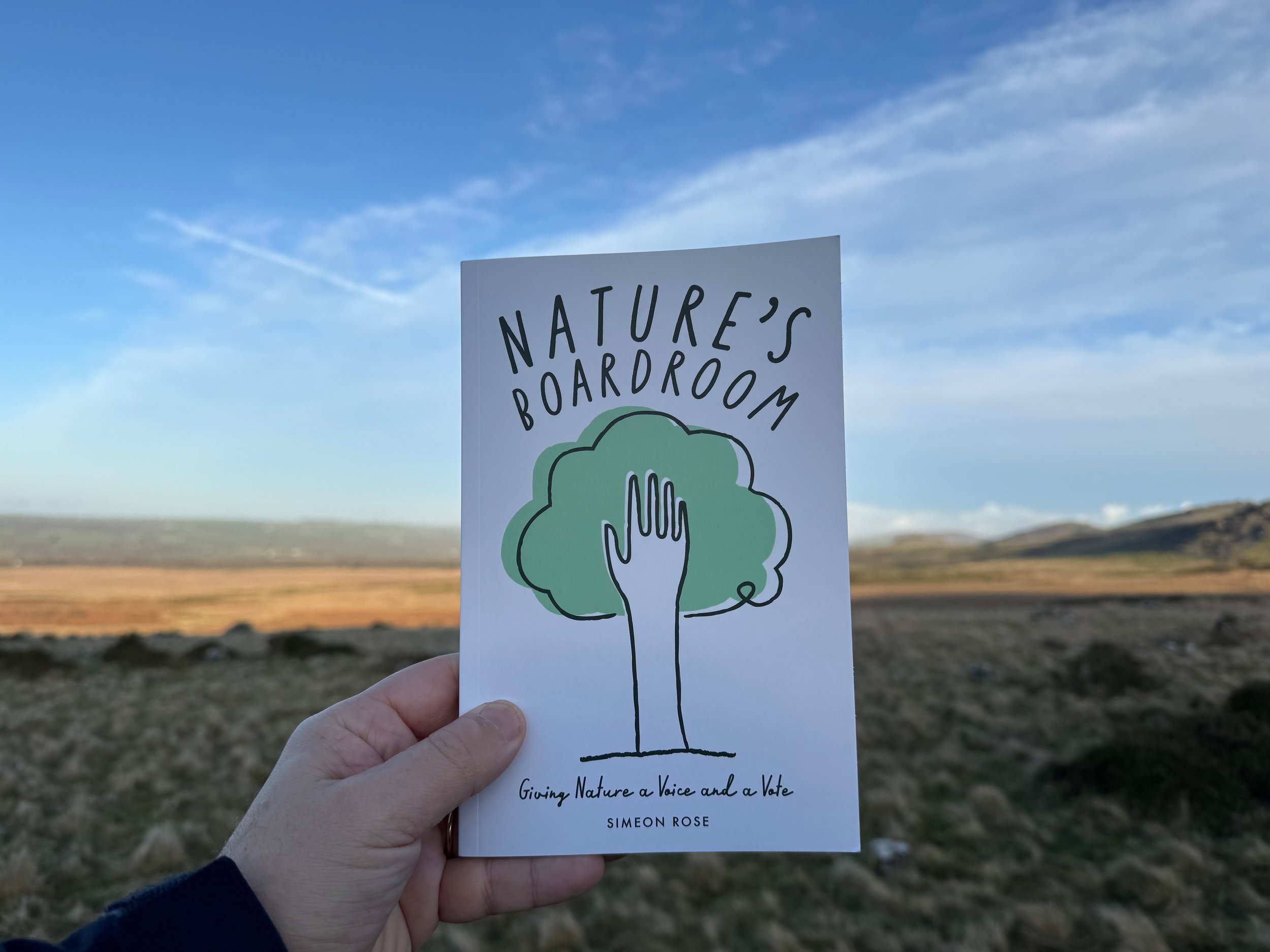
Nature’s Boardroom, held aloft above a Welsh bog. Published by Bristol University Press and out now.
When I was researching how to write Nature’s Boardroom, I stumbled upon some advice that suggested writing for the me of five years ago — and that’s been my guide throughout. It’s prescient too, that this book is now published almost exactly five years after we started work on Nature on the Board — which began in early 2021 when Anne asked ‘What if Nature really was the boss?’ That led to Faith In Nature appointing Nature to its board in September 2022 and to the open-source idea that is, generally, referred to today as ‘Nature on the Board’ (NOTB).
Back in 2021, once we’d had the idea, figuring out what next was… interesting! There were dead-ends, false-starts, cold-calls, crash courses in stuff we knew nothing about and sudden bursts of inspiration and serendipity. The bit that unlocked it all was a conversation around a fire on a starry night (cliched, but true!) with our friend Amy Wright who’d previously worked in indigenous land rights in Australia. She pointed us in the direction of stories that blew our minds, and those led us to Paul Powlesland of Lawyers for Nature here in the UK and Grant Wilson of Earth Law Center in the US. We are forever grateful to them for actually picking up the phone and running with us on this. And, ultimately, for bringing in Brontie Ansell who pulled together the framework that underpins so much of the framework.
And although Nature on the Board has since received more coverage than we ever expected, it’s spread thin across the web in bits here and pieces there. There are podcasts, news reports, films, blog articles and links (that lead to yet more links) but no single resource that consolidates all of this into one place. Which is why, when Bristol University Press asked if I’d like to write that missing piece — this book — I said yes, of course.
NOTB was designed to be democratised. It is intended to inspire, to encourage creativity and to reimagine our relationship with the natural world — not just through its words, but in its practical real-world application. I know it can do that because I’ve seen it at work. So too can the the roughly 25 other organisations that have implemented it so far. Collectively, we are proving this does work.
The book lays out the Why, the What and the How of NOTB — as well as my hopes of Where Next. In the short term, Where Next should be a much greater uptake of the framework. I know there are people out there thinking much the same way we were five years ago — because I now meet them all the time. So if you’re one of those people, I hope Nature’s Boardroom helps you move closer towards realising the power we all have in reshaping our systems. I hope it helps us co-create s system that better serves all life on Earth.
I hope too that in five years’ time, I can revisit Nature’s Boardroom and pack it full of case studies that are yet to be born. I hope you will share your success stories with me. And I hope in (not too many) years to come, we can all look back at this book as some strange oddity from a time before humanity thought to consider the needs and wants of the wider natural world, of which we are alla part.
But, one step at a time. You can buy Nature’s Boardroom in all the usual places you’d expect to buy books, and directly from the wonderful Bristol University Press, here.
I hope it does its job. Please put it to work.
Thanks,
Simeon.